
If you don’t know anything about the conflict here’s a (very) brief overview:
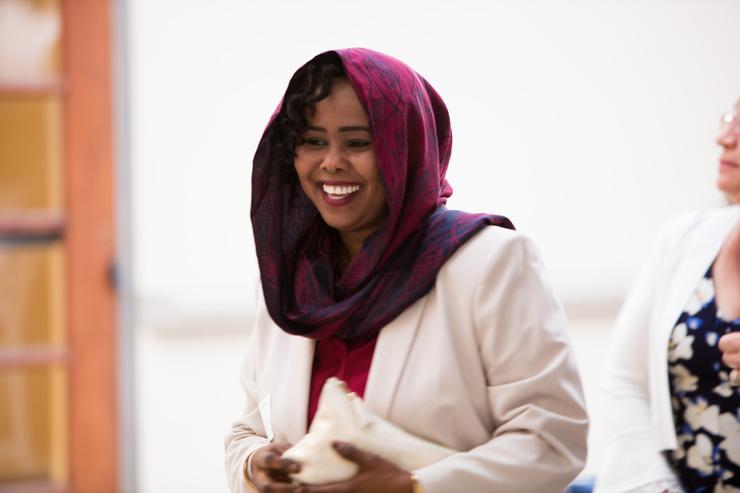
begin quotOn first impression, Amira is a tiny woman, who has a soft voice and the most fabulous fashion sense. Yet when she starts speaking, her words are powerful and her message is strong, and she seems to stand taller as she speaks with pride about the women in SudanThe Kroc School organizes a program called the Women Peacemakers, where each year four women from across the world come to San Diego to share, research and document their current journey as peacemakers. As part of one of my class, War, Gender and Peacebuilding, we get to have sessions with each of the four women.
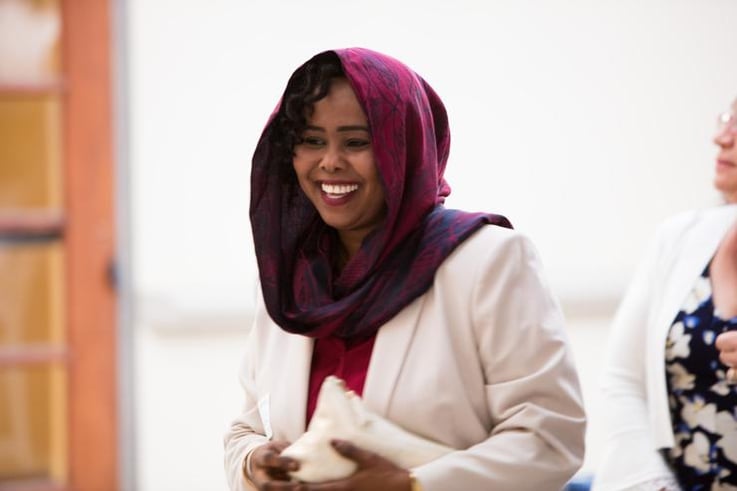
2018 Woman PeaceMaker Amira Abdulrahman Hussein Timan
Until 2011, South Sudan and Sudan were one country. They were initially colonized by the British who led the regions differently, which created systemic perceptions and divisions between people. After 2 civil wars between 1956 (decolonization) and 2011, the country became two; Sudan and South Sudan. Darfur is in Sudan, and is cut off from the capital city. It has suffered conflict that is so complex and multifaceted that the various peace agreements have not been able to resolve the conflict.
Many, many factors and actors are involved in the history of Sudan, and Amira did a really great job of explaining it succinctly.
The work that Amira does is based on ensuring that women are able to find independence, security and community in the tumultuous post-conflict society of Darfur, particularly in refugee camps. She has been instrumental in creating the most recent peace treaty — Doha Documents for Peace in Darfur (DDPD), and continued to exert her knowledge and experience at the grass root level. Currently she works at the UN where she admits it is not as satisfying as her grass roots work because it is based more on broad-scale contributions, rather than community action.
Her knowledge and philosophies are completely inspiring. When describing the first time that women were allowed at the negotiating table in Sudan, she is astute about their strategies in comparison to men.
“Women focus on details; men don’t do that”
For example, refugee camps provide difficult living spaces, particularly for women. It is the women who have created a forum to help those living there struggling, rebuild their lives. They have a private, safe place that they can go to get professional help, and eventually learn skills, earn some money, and become independent. It is the women who have created a conference to discuss the holistic challenges — not merely structural — that the country faces.
Her story is both deflating and inspiring. How can so much hardship, terror, and brutality exist? Every day it seems as though the world becomes more unforgiving. Yet there is a paradox. There are such resilient, brave people working to rectify the wrongdoing, such as Amira, and it gives me hope.
I can’t comprehend the atrocities that those in Sudan and South Sudan have suffered, yet I can empathize, and ensure that my place as a privileged person at the Kroc School is used to facilitate further discussion of what needs to be achieved in order to find peace. People such as Amira really give me strength and humility in order to continue doing what I do. I look forward to further interactions with the women from the program.
N.B. I’d like to personally thank Amira for being so altruistic and so willing to help me with this piece. She is both a powerhouse and public champion, and also someone who you know truly cares about each and every individual.
This post originally ran on Kroc School MA in Peace and Justice student Beth Brookes-Lamdin's blog, livinthedreamdotdot.wordpress.com
Contact:
Kevin Dobyns
kdobyns@sandiego.edu
(619) 260-7618