
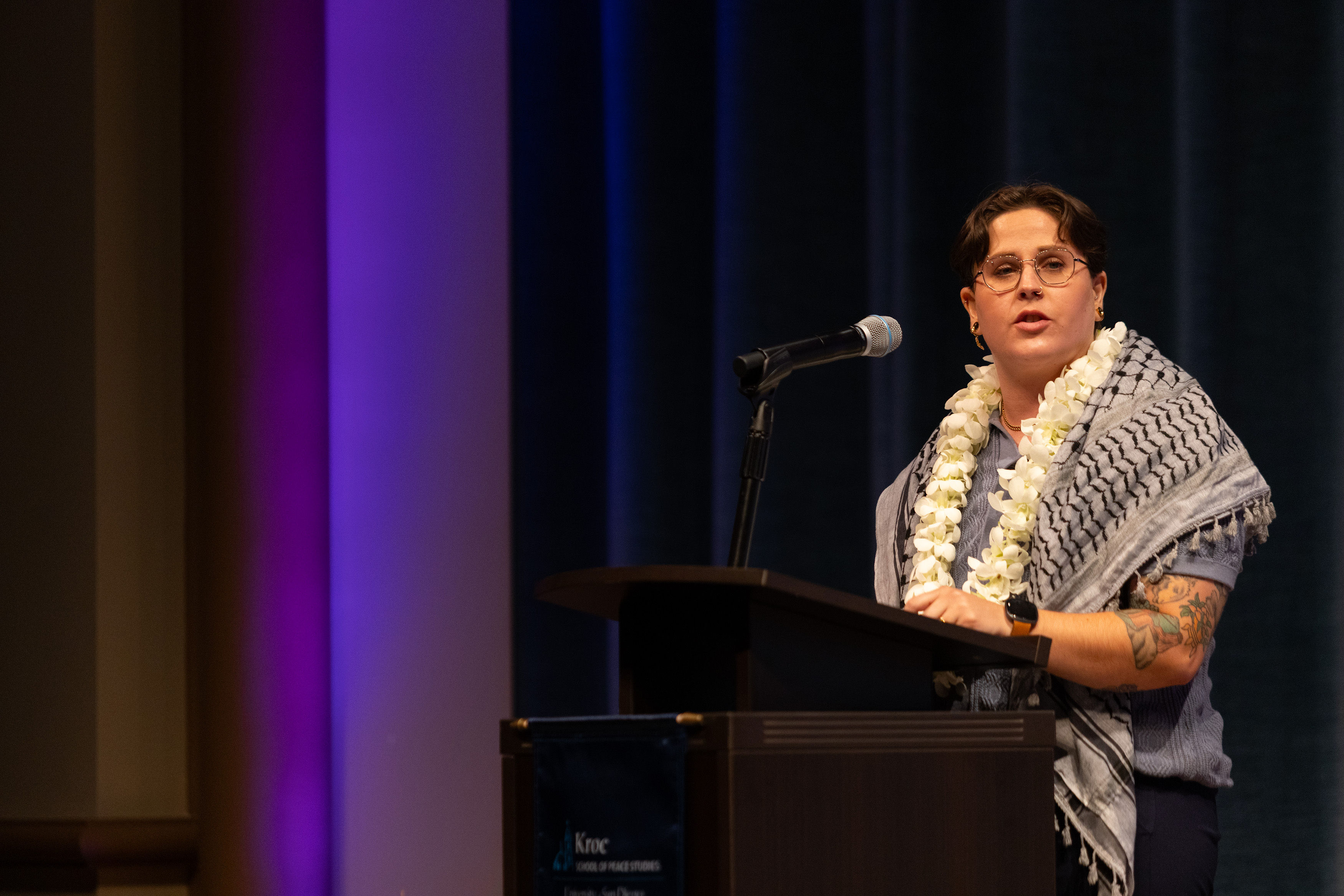
The following speech was delivered by Rowan Hepps Keeney, Class Speaker for the MS in Conflict Management and Resolution program at the 2025 Kroc School Award Ceremony. Read more about the celebration here.
Good afternoon, everyone,
It’s an honor to be here with you today—to reflect not just on what we’ve accomplished, but on what it’s meant to do this work together—even when the odds feel impossibly stacked against us.
I want to begin by naming that we are gathered on unceded Kumeyaay land. This land holds its own history of harm and resistance. The ongoing colonization, genocide, and land theft of Indigenous peoples continues to shape every system we seek to transform—and as future peacebuilders, that history must live in us.
We cannot claim to build justice without knowing where we stand, who was displaced to make way for our institutions, and what repair might actually require.
So I ask now that we take a brief moment of silence to honor the Kumeyaay people and all Indigenous communities whose lands we occupy, whose stories we carry, and whose liberation is bound to our own.
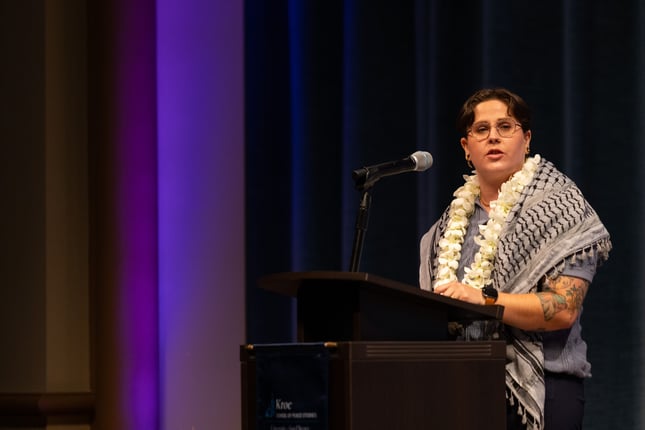 Rowan Hepps Keeney delivering their speech
We arrived at the Kroc School during a time of deep precarity, polarization, and pain—none of which shows signs of dissipating any time soon. In just these past two years, we’ve witnessed the violent rise of fascism and white supremacy, the resurgence of authoritarian regimes, and countless atrocities, including the relentless genocide in Gaza—a crisis that demands our attention, our outrage, and our action.
We’ve seen student protestors criminalized, detained, and even deported for calling for justice. We’ve watched institutions try to suppress truth in the name of “safety.” And yet—here we are. Not untouched by the grief of this moment, but galvanized by it.
And so we’ve asked hard questions—about systems, about ourselves, and about what kind of peace work we actually want and feel called to do. We’ve faced ourselves in ways many people go their entire lives avoiding.
This program has not just taught us how to manage conflict—it has taught us to confront the very systems that produce it. Systems that will not change unless we—those of us in this room—commit relentlessly to the work of dismantling them. And that dismantling must begin within ourselves. With our own unlearning. With our own willingness to disrupt patterns of silence, complicity, and comfort.
Anti-racist practice, trauma-informed care, sustainable solutions—these are not just frameworks. They are daily commitments. They are muscle memory we build over time. They are choices we make in rooms where it would be easier to stay quiet.
Together, we can continue to cultivate spaces where theory is grounded in lived experience, where scholarship demands urgency, and where we can hold each other through the inevitable missteps and setbacks along the way.
So today, we celebrate. We celebrate our resilience, our brilliance, the Krocodiles finally winning a soccer game. And we celebrate all of you: the people who kept us standing when we were ready to rip our hair out and throw it all away for one good night of sleep.
But let this also be a call to action. Because we didn’t just gain degrees—we gained a responsibility. It’s a privilege to study conflict in a classroom. That privilege demands action. It demands discomfort. It demands we use every bit of what we’ve learned to resist shallow peace, and insist on something messier, something deeper. Something real. Because peace is not passive. Peace is not polite. Peace requires courage, confrontation, and, yes, reparations.
We are peacebuilders. We are troublemakers. We are facilitators of reckoning. And the work doesn’t start when we leave here. It started long before we arrived. And it continues—with us. Congratulations, Kroc Class of 2025. Let’s get to work.
.webp)